
Why Russia and China Need the Middle East More Than Americans Realize

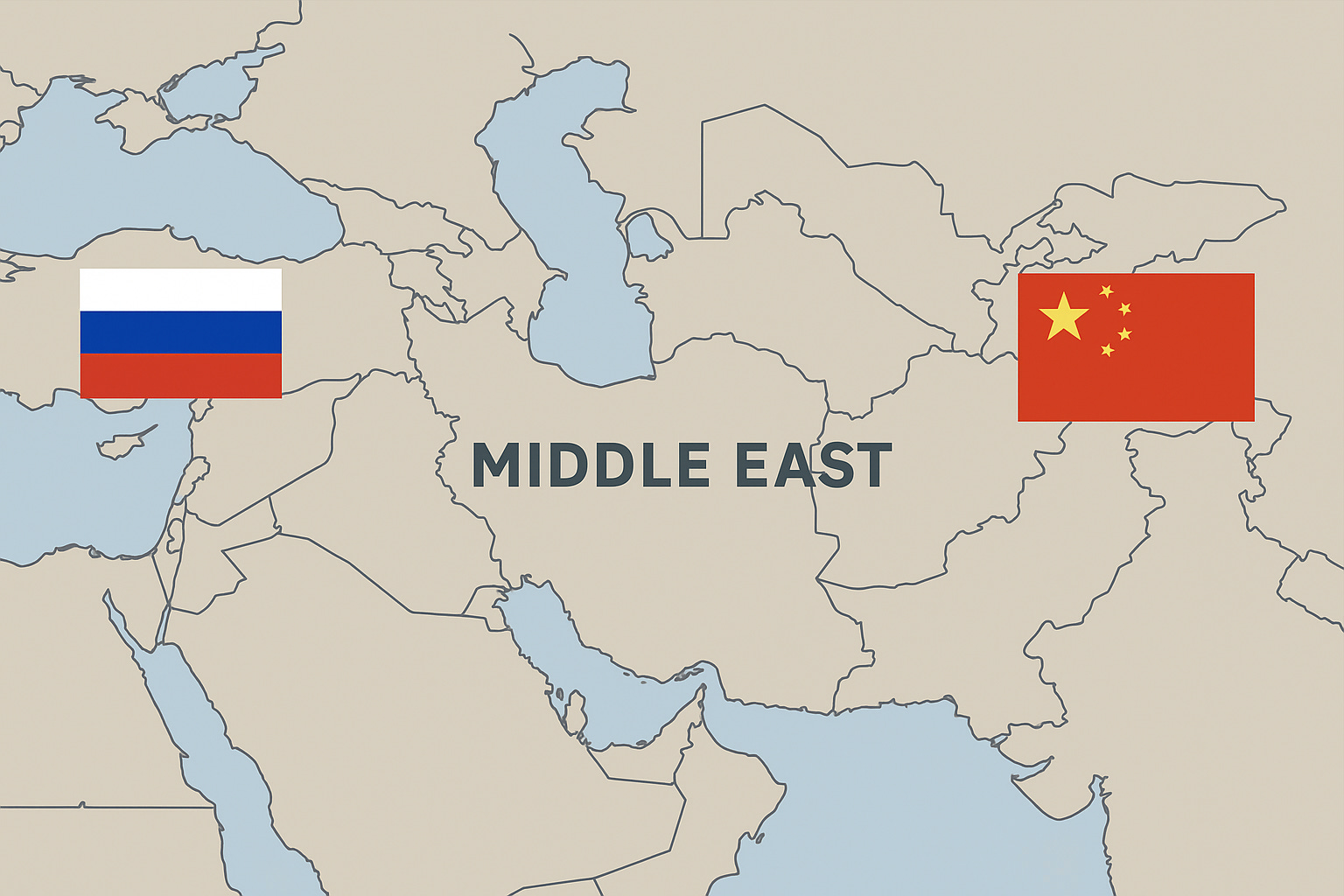
American audiences often see the Middle East through the lens of U.S. alliances, conflicts, and regional instability. But in a recent Breaking Battlegrounds conversation, Hudson Institute research fellow Zineb Riboua explained why the region is also central to the strategies of two of America’s biggest competitors: Russia and China.
Her overview was direct—each great power needs the Middle East, but for very different reasons. Understanding those motivations is key to understanding the next decade of global power competition.
China’s Priority: Energy and Influence
China’s interest in the Middle East is driven overwhelmingly by energy security. According to Riboua, China relies on the region for roughly 45% of its oil and gas supply. That dependency makes the Middle East one of the most important pillars of China’s long-term strategic planning.
Beyond energy, Riboua noted that China is building political influence by presenting itself as the leader of the “global South”—championing an alternative to the U.S.-led international order. For Beijing, the Middle East and North Africa are essential territories for expanding that influence, whether through trade, diplomacy, technology, or investment projects.
While studying in Morocco, Riboua saw this expansion firsthand: an influx of Chinese entrepreneurs, business interests, and infrastructure proposals. Those early observations sparked her deeper research into China’s ambitions in the region.
Russia’s Priority: Geopolitics and Access
Russia’s presence in the Middle East is driven by strategic geography rather than energy needs. As Riboua explained, Moscow sees the region as essential for several reasons:
Geopolitical leverage through multilateral organizations
Influence over regional conflicts and political transitions
Strategic access to the Mediterranean Sea, which Russia secured by supporting the Assad regime in Syria
Continued activity in Libya, another gateway to maritime access and regional sway
For Russia, the Middle East isn’t simply another arena—it’s a pivotal region that enhances its global posture, strengthens its partnerships, and complicates U.S. strategy.
Why the Middle East Matters for All Great Powers
Riboua emphasized that the Middle East remains one of the most strategically concentrated regions in the world:
The highest density of global energy resources
The highest concentration of U.S. allies
The intersection of trade, ideology, and military influence
Any country seeking global power—whether the United States, Russia, or China—must compete for influence there.
A Region at the Center of Global Competition
The conversation concluded with Riboua reflecting on her early observations as a student. Seeing China’s growing footprint in Morocco raised the key question she now studies professionally: Why are these powers expanding so aggressively in the Middle East?
Her answer underscores the core of today’s multipolar world. The Middle East is no longer a region defined solely by its internal challenges. It is a central arena in the struggle for global leadership—and Russia and China are investing deeply in shaping its future.
Transcript
Chuck Warren: So what is Russia and China’s role in the Middle East and North Africa that Americans would not understand? And you have two minutes on that question.
Zineb Riboua: Yeah, sure. So my assumption as someone who works on this is that Russia is a great power. China is a great power. They both need the Middle East for different reasons. China mainly for energy. It takes 45 % of its oil and gas from the Middle East. Russia, not much because of the energy, but because of the importance of the Middle East geopolitically. It is a very important region in terms of coordinating, for example, through two different multilateral organizations, which Russia actually needs, for example, to push its own agenda.
It’s also a region that is very important for Russia in terms of having access to the Mediterranean Sea, which is why the Russians went to Syria, for example, to save Assad at the time. And which is why the Russians are in Libya for example. So there are different reasons why each country is in the region but I would say that in general the Middle East is a key region in the world.
It has the highest concentration of resources and the highest concentration of U.S. allies which tells you how much it actually matters politically for any country that wants to have influence in the world.
And so at the time, as I was a student, I would see, for example, China rising. In Morocco, would see a lot of Chinese entrepreneurs, et cetera. And I found that very intriguing. Why would they be there? And so I started investigating. And it was a lot more how China wants to be this leader of the global South, wants to be a leader to a parallel order to the one of the United States. And we see all of these countries very important to do so.
Sam Stone: Absolutely. Thank you. Zineb Riboua, we’re coming right back here with more on Breaking Battlegrounds. Stay tuned.
Listen to the full episode of Breaking Battlegrounds anywhere you stream your podcasts!