
The $1,700 School Choice Question That Could Split America

A quiet education revolution is underway in America, and whether your family benefits from it may depend entirely on what state you live in. On the latest episode of Breaking Battlegrounds, veteran California political strategist Jon Fleischman joined us to unpack a powerful but underreported provision inside what’s been dubbed the “One Big Beautiful Bill.” At the center of it is a federal school choice scholarship program that could redirect billions of dollars toward educational opportunity nationwide. But there’s a catch: states must opt in. And that’s where the growing divide between red states and blue states becomes impossible to ignore.
Federalism Cuts Both Ways
To understand what’s happening, you have to understand federalism. The 10th Amendment establishes distinct roles for the federal government and the states, preserving state autonomy in many domestic matters. In theory, that balance protects local decision-making. In practice, it can either accelerate reform or quietly block it. As Fleischman explained during our conversation, “There’s only so much help you can give to a state that doesn’t seem to want it.” That dynamic is playing out across policy areas. The federal government can offer support for fire recovery in Los Angeles, but it cannot override local permitting and decision-making. It can pass sweeping national legislation, yet still depend on governors and legislatures for implementation. Education is now one of the clearest examples of how that tension works.
How the Program Works
Signed into law on July 4th, the bill includes what may become one of the most significant school choice expansions in recent history. The structure is straightforward but impactful: taxpayers may redirect up to $1,700 per household taxpayer from their federal tax liability to a nonprofit organization that funds school choice scholarships. This means families do not pay additional money out of pocket; instead, they allocate part of what they already owe in federal taxes. The result is the creation of a potentially massive funding stream to support scholarships for students who may be stuck in underperforming schools while also introducing competition into existing school systems. It is designed to expand access and opportunity without increasing overall tax burdens.
27 States Have Already Said Yes
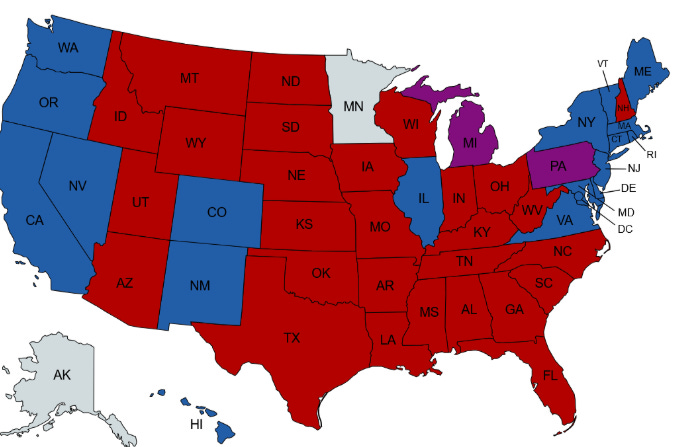
In a deliberate nod to federalism, Congress included a key requirement: for residents of a state to participate in the program, that state’s government must formally approve it. That approval can come either directly from the governor or through legislation passed by the state legislature and signed into law. Without that sign-off, taxpayers in the state cannot participate. As of now, 27 states have opted in, allowing their residents to begin participating starting with the 2027 tax year. Of those 27 states, 25 have Republican governors. The pattern is clear. Red states are embracing the program, while blue states have been slower to act or are resisting altogether, creating a widening gap in how federal policy is experienced across the country.
The California Question
Which brings us to California and Governor Gavin Newsom. California taxpayers contribute billions to the federal system each year, and under this program, they could redirect substantial resources toward scholarship organizations within the state. However, without approval from the governor or legislative action, Californians will be unable to participate while residents in other states move forward. This is where federalism becomes more than a constitutional abstraction. Two families with identical incomes — one living in Texas and one in California — could face entirely different educational opportunities based solely on decisions made in their state capitol. The divergence would not be driven by federal law, but by state-level political choice.
More Than Education
As Fleischman emphasized in our discussion, this issue reflects a broader trend. Policies emerging from Washington are increasingly being implemented differently depending on state leadership, and those differences are producing measurable divergence between red and blue states. Economic policy, regulatory environments, disaster recovery approaches, and now educational access are all shaped by state-level decisions layered on top of federal initiatives. The result is a country where opportunity, mobility, and policy outcomes may increasingly depend on geography.
The Bigger Picture
This debate ultimately extends beyond school choice. It raises deeper questions about the balance of power between federal authority and state autonomy, about whether governors should have effective veto power over federally authorized programs, and about how far the red state–blue state divide will expand in the coming years. The $1,700 question is not just about tax credits; it is about who controls access to opportunity and how governance decisions ripple through families’ daily lives.
If you care about education reform, federalism, and the growing divergence in state policy models, this episode of Breaking Battlegrounds is worth your time. Jon Fleischman brings 35 years of experience navigating California politics to a conversation that carries national implications. Listen to the full discussion wherever you get your podcasts, and stay tuned — because this debate is only just beginning.
Transcript
Sam Stone: Welcome back to breaking battlegrounds. We’re continuing on now with Jon Fleischman. He is the... at flash report or sodoesitmatter.com you definitely want to stay in touch with his work. He has dug into California politics for 35 years.
We want to get into some issues around educational choice that are in the big beautiful bill and how that affects, California Because of some of the things Gavin Newsom is doing. Right as we were going out, I was saying, you know you’ve kind of got this breakdown red state versus blue state that a lot of these policies Trump is implementing are being implemented one way in blue states and a very different way in red states.
And that’s creating kind of a break in the economy from what we’re seeing. But that applies to a lot of different stuff.
Jon Fleischman: It does.
Sam Stone: Yeah. So how much is someone like Gavin Newsom able to def- you know, diffuse essentially or push aside the Trump agenda with his powers in the state? Because I think we’re seeing a huge dichotomy between blue states and red states now.
Jon Fleischman: Yeah, so in a lot of cases what you’ve got is the pros and the cons of the 10th Amendment to the United States. If you embrace the idea of federalism and the idea that there’s a distinct role for the federal government on domestic affairs and a distinct role for state governments, you start to realize that there’s only so much help you can give to a state that doesn’t seem to want it. Right? So that really allows Gavin Newsom to have a lot of latitude.
I mean, just this week, EPA Administrator Zeldin and SBA Administrator Loeffler were in the palisades as President Trump issued an executive order talking about we’re gonna we’re gonna get fire recovery going in LA. But they’re quickly finding out there’s only so much you can do because the federal government doesn’t control permitting and decision-making at the local level but. And I’m just giving that as an anecdote.
Sam Stone: Right, no, it’s a great example.
Jon Fleischman: But maybe the best, my favorite example is the concept of federalism is in a key part of the one big beautiful bill act that the president signed on July fourth of last year. And I think it’s one of the most significant programs. It’s an educational scholarship school choice scholarship program.
That basically says that if you’re a taxpayer you have the ability, whatever your tax liabilities to the federal government, for every taxpayer in your house you can delegate seventeen hundred dollars of that money that liability instead to a nonprofit that helps with school choice and take it straight off your federal tax bill. So it costs you nothing and it creates a massive reservoir of money to help create opportunity choice for those kids who may be stuck in a school that is not the best-serving school or bringing in some competition into the school system.
But what Republicans did, and again in an ode to federalism, they said in order for the taxpayers in a state to be able to participate in this program, there has to be sign-off by the state government, which the IRS has ruled to mean either the governor or a bill through the governor and signed by the legislature and signed by the governor.
And so far, as of today, 27 states in the United States have joined this program, allowing their federal taxpayers in their state to participate in this program, starting with the 2027 tax year. But there are states in the, and by the way, of those 27, 25 of them have Republican governors.
Listen to the full episode of Breaking Battlegrounds anywhere you stream your podcasts!